
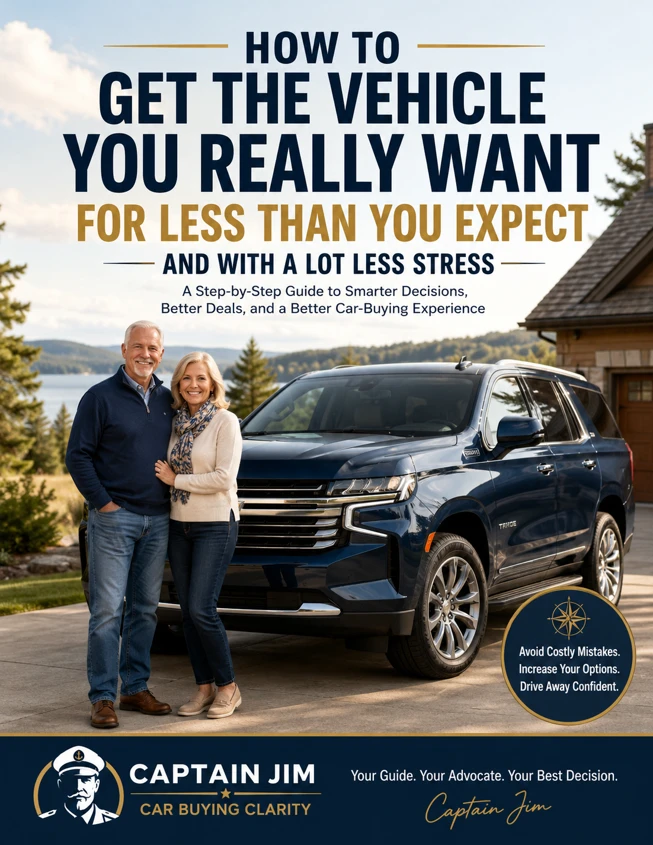
How to Get the Vehicle You Really Want for Less Than You Expect
Captain Jim’s Complete Guide to Buying Smarter, Spending Less, and Eliminating Stress
By Captain Jim
Why Most Buyers Spend More Than They Should
Buying a vehicle is one of the largest financial decisions most people make outside of purchasing a home. Yet the process creates far more stress, confusion, and frustration than it should.
The surprising truth is that the most expensive car buying mistakes happen long before someone ever steps foot inside a dealership.
They happen when buyers start looking at vehicles before understanding their needs. They happen when emotions take over. And they happen when people focus on one part of the transaction while overlooking the bigger picture.
This guide changes that.
After more than 20 years helping thousands of buyers, Captain Jim created this comprehensive resource to walk you through the entire process from start to finish. Not just how to find a car. How to make the right decision.
The Complete Car Buying Clarity Guide
What You’ll Learn in This Guide:
- Why most buyers start in the wrong place and how to fix that immediately
- The Sherlock Holmes Method for eliminating bad choices and finding clarity fast
- Why chasing the "perfect deal" actually costs you more
- How to evaluate the complete ownership experience, not just the vehicle
- What to do with your current vehicle: trade it, sell it, or keep it
- How flexibility creates opportunities most buyers never see
- How to reduce stress before you ever visit a dealership
- Why the vehicle you really want may not be the one you originally expected
- How to move from analysis paralysis to calm, confident decision making
Get the Free Flagship Guide
Enter your email below to access Captain Jim’s most comprehensive car buying guide and download your copy instantly.
- Your email will never be sold or shared

Most Buyers Start in the Wrong Place
If you’ve ever felt overwhelmed while shopping for a vehicle, you’re not alone. Most buyers begin by looking at vehicles. That sounds logical, but it’s often where the confusion begins.
A person sees a vehicle online that catches their eye. Then another. Then another. Before long, they’re comparing dozens of vehicles, features, trim levels, incentives, reviews, and prices. The more information they gather, the more difficult the decision becomes.
The problem isn’t a lack of information. The problem is starting the process before defining what really matters.
Before you begin comparing vehicles, it’s important to answer a few simple questions:
- How will I primarily use this vehicle?
- Who will regularly ride in it?
- How important are fuel economy, comfort, technology, towing, cargo space, or safety?
- How long do I plan to keep it?
- What monthly payment or overall budget feels comfortable?
- What would make me happy with my decision three years from now?
The answers create clarity. And clarity is one of the most valuable tools a buyer can have.
The Difference Between Wants and Needs
One of the biggest challenges buyers face is separating what they want from what they need. There’s nothing wrong with wanting something. But when buyers confuse wants with needs, they often limit their options and increase their costs.
A family with three children may need a third row of seating. Someone who regularly tows a boat may need a certain towing capacity. Those are needs. A particular wheel design, a specific exterior color, or a certain trim package may be wants.
Understanding the difference opens more doors than most people realize.
How Clarity Saves Money
Many people believe the secret to saving money is negotiating harder. But often the biggest savings occur before negotiations ever begin.
When you’re clear about your actual needs, you eliminate vehicles that don’t fit. You avoid paying for features that don’t add meaningful value. You make decisions faster. And you reduce the chances of buyer’s remorse.
The goal isn’t to find the perfect vehicle. The goal is to find the vehicle that best fits your needs, budget, and lifestyle.
The Sherlock Holmes Method
One of the biggest mistakes car buyers make is trying to find the perfect vehicle before eliminating the wrong ones.
Most buyers begin by looking at hundreds of possibilities. They compare endless makes, models, trim levels, colors, options, prices, and reviews. The result is information overload. Instead of becoming more confident, they become more confused.
The better approach is to eliminate bad choices first.
Instead of asking, “What is the perfect vehicle?” ask, “What vehicles clearly do NOT fit my situation?”
That question is often much easier to answer.
Each bad option you remove makes the remaining choices stronger. Eventually, you aren’t choosing from fifty possibilities. You may only be choosing from three or four. And that’s where confidence starts to appear.
Most people don’t need more choices. They need fewer, better choices.

The Myth of the Perfect Deal
Many car buyers spend months searching for the perfect deal. The problem is that the perfect deal doesn’t exist.
Every vehicle purchase involves tradeoffs. A vehicle might have low miles but cost a little more. A vehicle might have a lower price but be missing some features. A vehicle might be available immediately but not be your favorite color.
The goal is not to find the perfect deal. The goal is to find the right deal.
The right deal fits your needs, your budget, and your goals. It’s a vehicle you can feel good about driving home. It’s a decision that makes sense for your situation.
When you focus on finding the right deal instead of the perfect deal, the pressure begins to disappear.
The Vehicle Is Only Part of the Decision
When most people think about buying a vehicle, they focus almost entirely on the vehicle itself. But buying a vehicle is not just about choosing a vehicle. It’s about choosing a complete ownership experience.
Two vehicles may look nearly identical on the surface yet create completely different ownership experiences over the next several years. One may cost less today but cost more to insure. One may have a lower payment but depreciate more quickly. One may have attractive features but higher maintenance costs.
Everything Is Connected
Many car buyers evaluate each part of the buying process separately. They think about the vehicle. Then the trade in. Then the financing. Then the monthly payment. Then the timing. The problem is that these pieces rarely operate independently. They’re connected.
The vehicle you choose affects financing. Financing affects monthly payments. Monthly payments affect affordability. Affordability affects vehicle choices. Vehicle choices affect trade in strategy. And timing can influence all of the above.
Instead of asking, “How do I get the best trade value?” ask, “How do I create the best overall outcome?”
That question often leads to better answers.
What Should You Do With Your Current Vehicle?
Your current vehicle may be one of the most important pieces of the entire transaction. Yet many buyers spend far more time researching their next vehicle than evaluating the one they already own.
Before making any decisions, understand the difference between market value and emotional value. The marketplace doesn’t assign value based on memories. It assigns value based on condition, mileage, age, demand, and market conditions.
Many buyers assume they only have two choices: trade the vehicle or sell it privately. In reality, there is a third option. Keep it. And sometimes that’s the best option available.
For a deeper comparison of trading in versus selling privately, check out our guide on trade in vs selling your car privately. And for practical steps to increase your trade in value, our guide on maximizing your trade in covers the process step by step.

Flexibility Creates Opportunity
One of the fastest ways to make vehicle shopping more difficult is to become locked into one exact outcome.
When buyers become too rigid, they sometimes lose negotiating leverage. But when buyers are open to multiple possibilities, they often gain flexibility throughout the entire process.
Buyers can save thousands simply by being willing to consider a second color choice or comparing similar models. This doesn’t mean compromising on the things that truly matter. It means remaining open to possibilities you may not have considered.
Two powerful questions to ask yourself:
- What am I unwilling to compromise on?
- What am I willing to be flexible about?
Those two questions often create tremendous clarity.
How to Reduce Stress Before You Ever Visit a Dealership
One of the biggest mistakes buyers make is waiting until they arrive at a dealership to start making decisions. By that point, emotions are involved. Time pressure may exist. And information can begin arriving faster than it’s processed.
The good news is that much of the stress can be reduced before you ever step foot on a lot.
Step 1: Understand your budget. Not just the monthly payment. The entire ownership experience. Insurance. Fuel. Maintenance. Registration. Our guide on how much car you can actually afford helps you think through this clearly.
Step 2: Prepare your credit. Even small improvements can create better financing opportunities. Our guide on improving your credit walks through 13 practical ways to strengthen your score.
Step 3: Prepare your current vehicle. If you plan to trade it, gather maintenance records. Clean the vehicle thoroughly. Address simple cosmetic issues.
Step 4: Answer important questions before you begin shopping. What is my realistic budget? What features are true needs versus wants? How long do I expect to keep the vehicle? What ownership costs should I consider?
The more of these questions you answer ahead of time, the easier the buying process becomes.

The Vehicle You Really Want May Not Be the One You Think
One of the most interesting things Captain Jim has observed over the years is how often buyers end up choosing a different vehicle than the one they originally came in looking for. And surprisingly, many of them end up happier because of it.
The goal of vehicle shopping is not to prove your original assumption was correct. The goal is to find the vehicle that best fits your needs, budget, lifestyle, and priorities.
A powerful question to ask yourself: “If I didn’t already have a favorite vehicle in mind, which option would make the most sense for my situation?”
That question helps separate emotion from evaluation. Sometimes the answer confirms your original choice. Sometimes it points you in a different direction. Either outcome is a win.
Why Buyers Get Stuck and How Confidence Helps Them Move Forward
One of the biggest reasons buyers get stuck is that they believe they need complete certainty before making a decision. Unfortunately, complete certainty rarely exists.
Another common reason is analysis paralysis. At first, gathering information is helpful. But eventually there comes a point where additional information stops creating clarity and starts creating confusion.
The calm and confident buyer recognizes when enough research has been done. They understand that no vehicle is perfect. No ownership experience is perfect. And no transaction is perfect. But a thoughtful, informed decision is usually far better than endless hesitation.
The most successful buyers focus on what matters most:
- Does this vehicle fit my needs?
- Does it fit my budget?
- Will it serve my lifestyle well?
- Will I feel good about this decision six months from now?
Those questions matter far more than trying to squeeze out one last tiny advantage.
What Makes This Guide Different
This isn’t a guide about finding the cheapest car. It’s a guide about making the smartest decision.
Most car buying advice focuses on negotiation tactics and dealer tricks. This guide focuses on something more powerful: your mindset, your preparation, and your clarity.
When those three things are in place, everything else falls into position.
Your Next Steps
Now that you’ve read through the key ideas, here’s how to put them into action:
- Review your needs. Identify what you truly need and separate those needs from your wants.
- Evaluate your current vehicle. Decide whether trading, selling, or keeping makes the most sense. Our trade in guide and private selling guide can help.
- Understand your budget. Factor in insurance, fuel, maintenance, and total ownership costs.
- Prepare your credit. Our credit improvement guide walks through practical steps you can take now.
- Stay flexible. The vehicle you ultimately choose may not be the one you originally expected. Keep an open mind.
- Explore the full Resource Library. Every guide is free and designed to help you with a specific part of the process. Browse all guides here.
Questions or Want Guidance?
If you have questions about the vehicle buying process, trade ins, financing, leasing, or vehicle selection, Captain Jim is always happy to help.
Call or text Captain Jim: (941) 786-6122
No pressure. No obligation. Just honest, straightforward guidance from someone who’s helped thousands of buyers make confident decisions.
Get the Free Flagship Guide
Enter your email below to access Captain Jim’s most comprehensive car buying guide and download your copy instantly.
- Your email will never be sold or shared
Browse other free car-buying guides
Avoiding Costly Car Buying Mistakes
Learn the most common mistakes car buyers make and how to avoid unnecessary stress, rushed decisions, and expensive regrets
13 Smart Ways to Improve Your Credit Before Buying a Car
Practical strategies to strengthen your credit score and unlock better financing options before you apply.
12 Smart Steps to Maximize Your Trade In Value
Simple preparation steps that can put hundreds or even thousands more in your pocket at trade in time.